The word Plasmolysis was generally derived from a Latin and Greek word plasma – The mould and lusis meaning loosening.
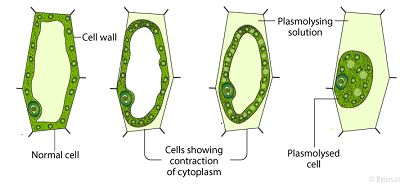
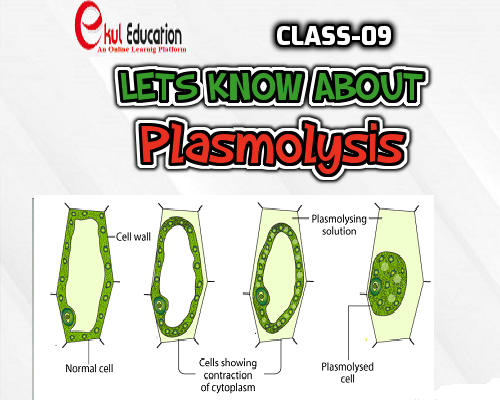
Plasmolysis is defined as the process of contraction or shrinkage of the protoplasm of a plant cell and is caused due to the loss of water in the cell. Plasmolysis is an example of the process osmosis and rarely occurs in nature.
EXAMPLES OF OSMOSIS
Shrinkage of vegetables in hypertonic conditions.
Blood cell shrinks when they are placed in the hypertonic conditions.
When more amount of salt is added as the preservatives for food like jams, jellies, and pickles. The cells lose water due to higher concentration outside and become less conducive to support the growth of microorganisms.
TYPES OF PLASMOLYSIS
On the basis of the final structure of the cytoplasm, there are mainly two types of plasmolysis.
Concave Plasmolysis
Convex Plasmolysis
CONCAVE PLASMOLYSIS
During the concave plasmolysis, both the cell membrane and protoplasm shrink away and begins to detach from the cell wall, which is caused due to the loss of water. Concave plasmolysis is a reversible process and it can be revised by placing the cell in a hypotonic solution, which helps calls to regain the water back into the cell.
CONVEX PLASMOLYSIS
During the convex plasmolysis, both the cell membrane and protoplasm lose so much water that they completely get detach from the cell wall. Later, the cell wall collapses and results in the destruction of the cell. Similar to concave plasmolysis, convex plasmolysis cannot be reversed, and this happens when a plant wilts and dies from lack of water. This type of plasmolysis is more complicated compared to convex plasmolysis.
QUESTIONS FOR SELF EVALUATION
What happen when a cell is placed in hypertonic solution?
What happen when a cell is placed in hypotonic solution?
1- the cell will shrink if the cell is placed in hypertonic solution .
2-when a cell is placed in a hypotonic solution then the water enters the cell toward the area of higher solute concentration .
3-plasmolysis is the process of contraction or shrinkage of the protoplasm of the plant cell .
4-convex plasmolysis cannot be reserved .
Good..
Hypertonic solutions have less water than a cell.If you place an animal or a plant cell in a hypertonic solution, the cell shrinks, because it loses water water moves from a higher concentration inside the cell to a lower concentration outside.
Hypotonic solutions have more water than a cell. Tapwater and pure water are hypotonic. A single animal cellplaced in a hypotonic solution will fill up with water and then burst. This is why putting water on a bloodstained piece of clothing makes the stain worse.
contraction of the protoplast of a plant cell as a result of loss of water from the cell.
if the cell is placed in a hypotonic solution.

1- the cell will shrink if the cell is placed in hypertonic solution .
2-when a cell is placed in a hypotonic solution then the water enters the cell toward the area of higher solute concentration .
3-plasmolysis is the process of contraction or shrinkage of the protoplasm of the plant cell .
4-convex plasmolysis cannot be reserved .
Good..
Hypertonic solutions have less water than a cell.If you place an animal or a plant cell in a hypertonic solution, the cell shrinks, because it loses water water moves from a higher concentration inside the cell to a lower concentration outside.
Hypotonic solutions have more water than a cell. Tapwater and pure water are hypotonic. A single animal cellplaced in a hypotonic solution will fill up with water and then burst. This is why putting water on a bloodstained piece of clothing makes the stain worse.
contraction of the protoplast of a plant cell as a result of loss of water from the cell.
if the cell is placed in a hypotonic solution.
hello